AI Assisted Talent Acquisition Workflow
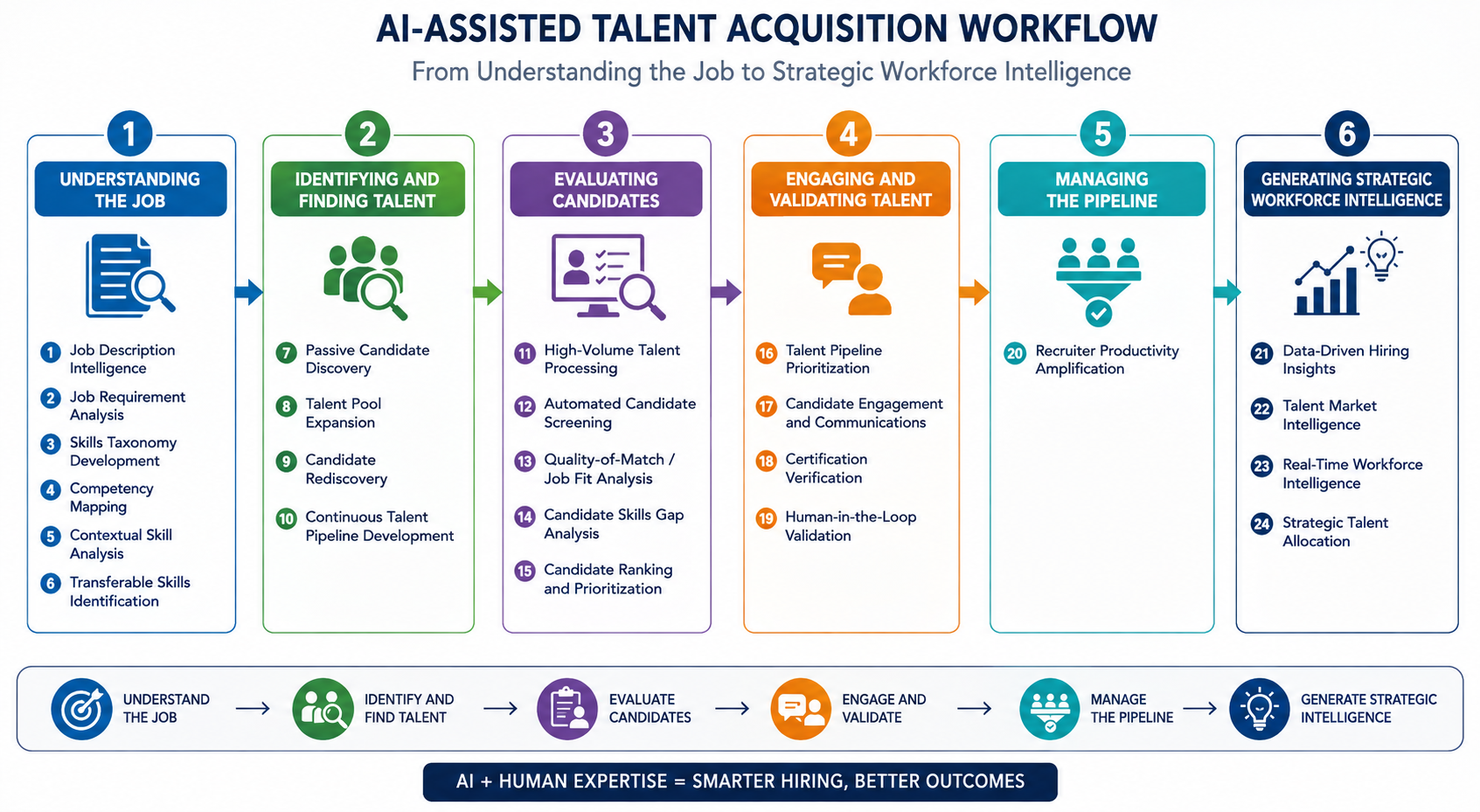
AI tools can evaluate candidates based on their actual skills, competencies and qualifications relative to job requirements, rather than relying on simple keyword matching. This capability allows AI to efficiently analyze very large talent pools and identify the candidates who are the strongest fit for a specific role. Because AI can rapidly read and process large volumes of information (potentially hundreds of pages of text in minutes) it can evaluate candidate profiles at a scale that would be impractical for recruiters to manage manually. This speed and analytical capability significantly increases the value and utility of your talent pipeline, helping recruiters identify qualified talent faster and more accurately.
Understanding the Job
• Job Description Intelligence: Analyzes job descriptions to identify required hard skills, soft skills, experience levels, certifications, education, and other critical qualifications.
• Job Requirement Analysis: Breaks complex job descriptions into individual requirements, allowing AI to evaluate candidates against each critical component of the position.
• Skills Taxonomy Development: The strategic process of creating a structured, hierarchical framework that classifies and organizes an organization’s required competencies, technical skills, and soft skills into a unified, shared language. It maps broad domains down to granular abilities, skills, knowledge and proficiency levels. It uses AI to parse resumes, projects, and market demands to build and update real-time frameworks of workforce capabilities.
• Competency Mapping: Maps individual candidate and employee capabilities to standardized competency frameworks, making it easier to understand workforce strengths and deficiencies.
• Contextual Skill Analysis: Understands skills within the context of a candidate’s work history, responsibilities, projects, and accomplishments rather than treating skills as isolated keywords.
• Transferable Skills Identification: Recognizes skills that can transfer from one industry, occupation, or job function to another, expanding the available talent pool.
Identify and Find Talent
• Passive Candidate Discovery: Identifies qualified professionals who may not be actively searching for employment but possess the skills, competencies and experience required for future opportunities.
• Talent Pool Expansion: Enables recruiters to evaluate substantially larger talent pools by rapidly processing large volumes of candidate information.
• Candidate Rediscovery: Searches existing talent databases to identify previously reviewed candidates who may now be qualified for new opportunities.
• Continuous Talent Pipeline Development: Continuously evaluates available talent and helps organizations maintain pools of qualified candidates before positions become vacant.
Evaluating Candidates
• High-Volume Talent Processing: AI can rapidly process extremely large volumes of text-based candidate information, enabling organizations to analyze talent pools that would be impractical to review manually. AI can scan large talent pools because it can read and process about 100 to 300 pages of text in one minute. This reading efficiency improves the utility of your talent pipeline.
• Automated Candidate Screening: Parses resumes, matches applicant profiles to job requirements, and filters candidates at scale. Evaluates candidates against the actual skills, competencies, experience, and certifications required for a position rather than relying solely on job titles or keyword matches. Converts unstructured resumes and CVs into structured candidate profiles, extracting employment history, skills, education, certifications, accomplishments, and career progression. Evaluates candidates’ previous responsibilities and accomplishments to identify transferable capabilities that may not be obvious from job titles alone.
• Quality-of-Match Analysis: Provides a more comprehensive view of candidate suitability by considering skills, competencies, experience, responsibilities, certifications, and demonstrated capabilities together.
• Candidate Skills Gap Analysis: Scans existing employee profiles to spot missing skills required for the current position and future business goals. Highlights the specific qualifications or skills a candidate may be missing while also identifying areas where the candidate exceeds the requirements.
• Candidate Ranking and Prioritization: Processes large candidate pools and produces a ranked shortlist based on the degree of alignment (fit) between candidate capabilities and job requirements.
Engage and Validate
• Talent Pipeline Prioritization: Continuously identifies candidates who are most closely aligned with current and anticipated hiring requirements.
• Candidate Engagement and Communication: Helps recruiters identify the most relevant candidates for personalized outreach and ongoing talent-pipeline development.
• Certification Verification: Identifies required certifications and compares them against candidate and employee profiles to highlight qualifications that are present, missing, or potentially outdated.
• Human-in-the-Loop Validation: Provides recruiters and hiring managers with AI-generated insights while maintaining human oversight and final decision-making throughout the hiring process than just tracking activity (like phone calls or emails), recruiter productivity evaluates how effectively effort converts into quality hires and successful placements. Metrics usually include:
– Time-to-Fill: The number of days from opening a job requisition to candidate offer acceptance.
– Quality of Hire: Long-term performance, retention, and manager satisfaction ratings of the new hires.
– Offer Acceptance Rate: The percentage of extended job offers that candidates formally accept.
– Submissions per Recruiter: The volume of qualified candidate profiles successfully delivered to hiring managers.
Generate Strategic Workforce Intelligence
• Data-Driven Hiring Insights: Converts large amounts of candidate and workforce information into actionable insights that can support recruiting, workforce planning, succession planning, and talent development.
• Talent Market Intelligence: Incorporates changing labor-market conditions, emerging skills, and evolving job requirements to help organizations anticipate future talent needs.
• Real-Time Workforce Intelligence: Continuously updates candidate and employee skill profiles as new experience, competencies, certifications, projects, and requirements emerge.
• Strategic Talent Allocation: Helps organizations identify where existing employees and external candidates can provide the greatest alignment with current and future business needs.
Popular Posts

Sales Talent Recruitment with AI Staffing Technology
March 06, 2025

Identifying Low Performing Managers
June 21, 2024

Customer Service Talent Assessment
June 21, 2024
AI Assisted Talent Acquisition Workflow
September 01, 2026
Leave a Reply