Monetizing Your AI Staffing Strategy
Business leaders and senior managers recognize that investing in AI staffing technology is no longer simply a technology decision—it is a strategic business investment designed to generate measurable returns and long-term competitive advantage. To justify these investments, organizations need more than innovation; they need clear use cases, measurable outcomes, and a defined path to monetization.
AI-assisted staffing is not a passing trend. It represents a fundamental shift in how organizations attract, hire, and optimize talent. As workforce dynamics evolve and competition for top talent intensifies, traditional recruiting models are being reimagined.
AI staffing technology creates a collaborative model that combines the precision of artificial intelligence with the judgment and expertise of recruiters and hiring managers. This human-AI partnership enables organizations to make smarter hiring decisions, accelerate placements, and identify stronger candidate matches—driving measurable gains in productivity, retention, and cost efficiency.
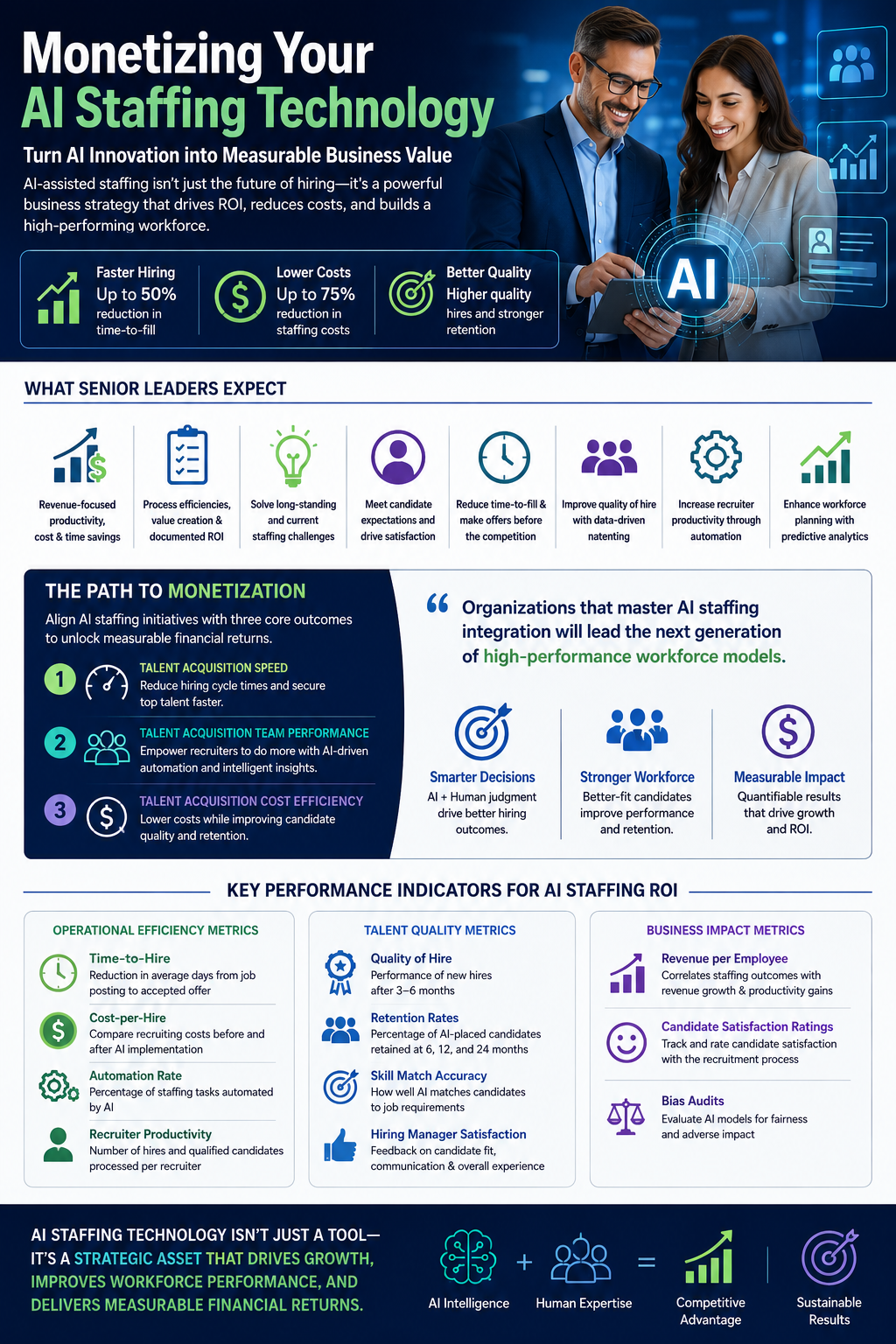
What Senior Leaders Expect from AI Staffing Investments
Senior managers want AI staffing solutions that deliver measurable business outcomes:
- Revenue-focused productivity gains and operational efficiencies
• Lower staffing costs and reduced time-to-hire
• Demonstrated process improvements and documented ROI
• Solutions for long-standing hiring challenges
• Improved candidate experience and satisfaction
• Faster hiring cycles and stronger competitive positioning
• Higher quality hires through intelligent candidate matching
• Increased recruiter capacity through automation
• Better workforce forecasting and planning through predictive analytics
The Path to AI Staffing Monetization
Successful AI staffing initiatives align directly with three core business outcomes:
Talent Acquisition Speed – Reduce hiring cycle times and secure top candidates before competitors.
Talent Acquisition Team Performance – Increase recruiter effectiveness through workflow automation and intelligent decision support
Talent Acquisition Cost Efficiency – Lower acquisition costs while improving candidate quality and retention.
Organizations that successfully integrate these capabilities will define the next generation of high-performance workforce models.
Key Performance Indicators for AI Staffing ROI
- Time-to-Hire – Reduction in average days from job posting to accepted offer
- Cost-per-Hire – Comparison of recruiting costs before and after AI implementation
- Automation Rate – Percentage of recruiting tasks automated through AI
- Recruiter Productivity — Number of qualified candidates and hires processed per recruiter
Talent Quality Metrics
- Quality of Hire — Performance evaluation of new hires after 3–6 months
- Retention Rates — Employee tenure at 6, 12, and 24 months
- Skill Match Accuracy — Measurement of candidate-job alignment
- Hiring Manager Satisfaction — Feedback on candidate quality and recruiting effectiveness
Business Impact Metrics
- Revenue per Employee — Relationship between staffing improvements and business growth
- Candidate Satisfaction Scores — Candidate experience and engagement ratings
- Bias Audits — Monitoring AI models for fairness and adverse impact
The organizations that generate the greatest value from AI staffing technology will be those that treat it not as a recruiting tool, but as a strategic business asset—one capable of improving workforce performance, creating measurable financial returns, and transforming talent acquisition into a competitive advantage.
Popular Posts

Sales Talent Recruitment with AI Staffing Technology
March 06, 2025

Identifying Low Performing Managers
June 21, 2024

Customer Service Talent Assessment
June 21, 2024
AI Assisted Talent Acquisition Workflow
September 01, 2026
Leave a Reply